Welcome back to the Ask the Expert Blog, where our engineers answer commonly asked ring and spring design questions. This week, our experts field some questions about retaining rings. Specifically, the production materials that are available and the details of shear load safety factors. For more than 100 years, Smalley has been the industry leader and technological pioneer of retaining rings and constant section rings. And for more than 50 years, Smalley has been revolutionizing the industry with compact wave springs. Whether you require a standard or custom solution, our dedicated team of engineers can design a solution for your target application performance.
I would like to know if you can provide spiral retaining rings made of titanium? We are currently using stainless steel retaining rings within titanium housings and we are experiencing interference and galvanic corrosion between the two metals.
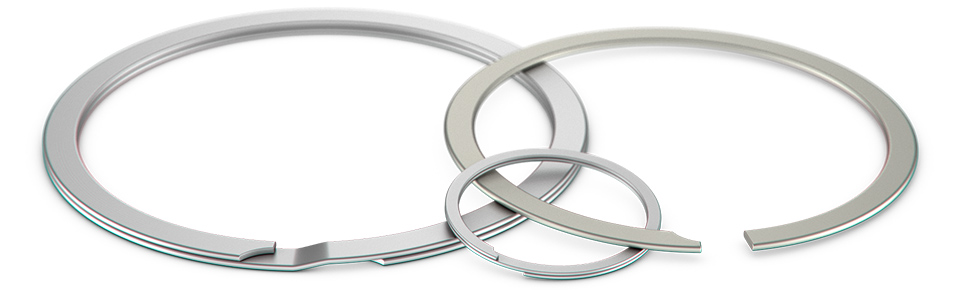
Smalley can manufacture spiral retaining rings out of titanium and a wide range of other alloys. Contact a Smalley Sales Engineer today to discuss your specific needs and the best material to meet them.
Is the shear load safety factor listed three times the advertised value? For example, the WH-62 lists “2500 (safety factor of 3)” — does that mean I can expect a failure at a load of around 7,500 lbs.?
That is correct. The values we list for ring shear have a safety factor of 3, so you can expect the actual ring shear to occur at 3 times the listed value.
However, our experience shows that the failure of a retaining ring is rarely ring shear. More often it is groove deforming, which allows the ring to work its way out of its groove. Groove depth, groove width, and the groove material can all play a part in how well a retaining ring performs.
You can contact a Smalley Sales Engineer today to discuss your axial loading needs and determine the best retaining ring for you.