
Ligue para nós: +1 (847) 719-5900
5 Common Misconceptions About Bearing Preload
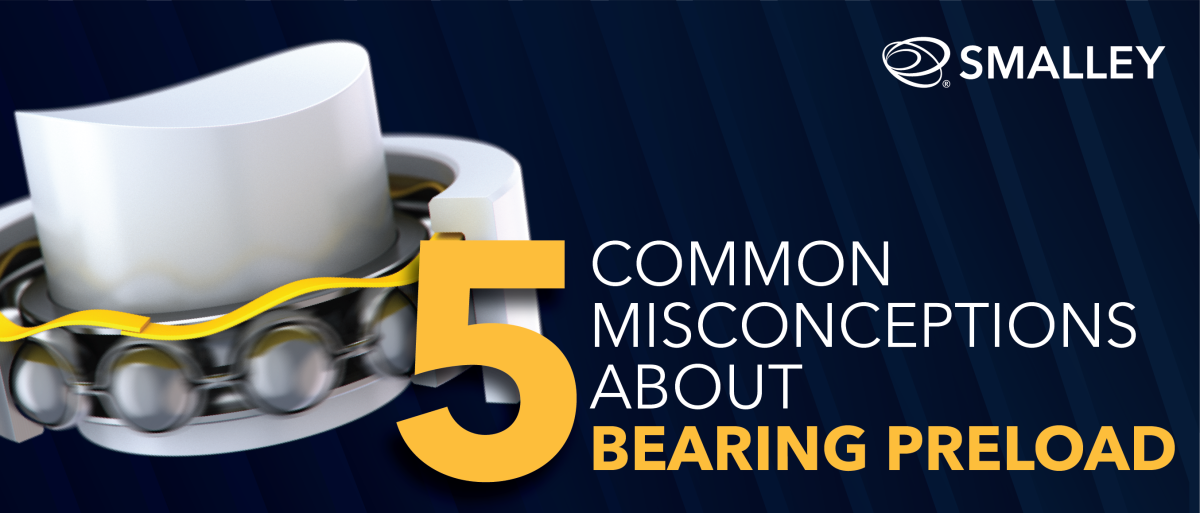
Proper bearing preload is essential for achieving rigidity, improving accuracy, reducing noise, and extending bearing life. Yet across industries, preloading remains one of the most misunderstood aspects of bearing design. Misconceptions often lead to premature failure, excessive heat generation, vibration, and reduced equipment reliability.
This whitepaper clarifies common misunderstandings and explains why Smalley’s wave springs offer a reliable, cost‑effective method for achieving consistent preload.
Misconception 1: Preload Only Matters in High‑Speed or High‑Precision Applications
Many engineers assume preload is only required in specialized systems. However, established engineering principles show that preload improves stiffness, reduces noise, and prevents rolling element skidding in standard ball bearing applications. Without preload, internal clearance allows rolling elements to shift before supporting load, increasing vibration and misalignment.
Misconception 2: More Preload Equals Better Performance
A common mistake is assuming higher preload guarantees stability. In reality, excessive preload increases friction and heat, accelerating lubricant breakdown and causing premature failure. Smalley’s wave springs help mitigate this risk by delivering controlled, predictable preload, reducing susceptibility to over‑tightening compared to rigid mechanical methods.
Misconception 3: Solid Preload Is Always More Reliable
Rigid or “solid” preload may appear precise, but it does not compensate for tolerance stack‑up, manufacturing variation, or thermal expansion. External loads and temperature shifts can change preload during operation, potentially unloading one bearing and causing skidding. Smalley wave springs naturally accommodate these shifts, maintaining stable preload across real‑world operating conditions.
Misconception 4: Any Spring Can Be Used for Preload
It’s easy to assume that any spring capable of providing axial load will perform the same, but this isn’t the case. Conventional wave washers often bind during compression, which leads to unpredictable loading behavior. Single-turn wave springs use gap and overlap end configurations that move freely during compression, preventing binding and ensuring consistent loading.
Misconception 5: Preload Reduces Design Flexibility
Concerns about lost design freedom often arise when preload enters the discussion. Yet preload helps manage variation rather than amplify it, allowing assemblies to perform more reliably even when tolerances are broader.
Spring‑based preload methods can accommodate minor misalignment, tolerance stack‑ups, and thermal shifts, reducing the need for overly restrictive machining requirements or tightly controlled fits.
Summary
Proper bearing preload is essential for maintaining consistent performance across many mechanical systems. When applied correctly, preload improves stiffness, reduces noise and vibration, and extends bearing life by keeping rolling elements in steady contact with their raceways. Even with these benefits, preload is often misunderstood, and incorrect assumptions about when to use it, how much to apply, or which method to choose can lead to unnecessary wear, heat generation, or reduced accuracy. By addressing these misconceptions, engineers can make more informed decisions. Leveraging spring-based preload methods provides a practical, reliable way to achieve stable loading in real operating conditions.
Preload recommendations and concepts described here are general in nature. Because bearing performance varies with application conditions, users should verify preload requirements based on their system’s specific loads, temperatures, tolerances, and operating environment.
Additional Resources
As always, our engineering team can assist you in designing a custom bearing preload spring for your unique application.
- Download or Request Smalley's Parts & Engineering Catalog
- Download Smalley's SSB Series Expansion Insert
- Request Free Samples to test in your application
- Send us your application requirements, and we'll find or design you the right part
Interested in learning more about wave springs? Check out our E-Book.
© 2026 Smalley Steel Ring Company. All Rights Reserved.
Entre em contato conosco