
Call Us: +1 (847) 719-5900
Standard Materials
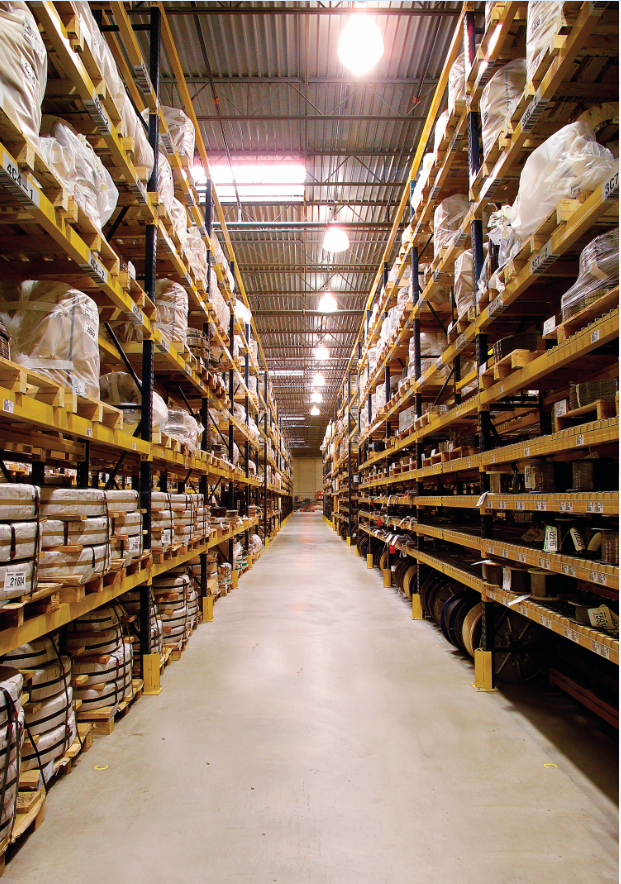
Selecting the proper material for an application requires a general knowledge of what is available. Smalley offers over 40 material options. Specifying the correct material can prevent additional costs and failure in operation.
Carbon steel is the most commonly specified material. Stainless steels, although more costly than carbon steel, provide far superior corrosion resistance and have higher temperature operating limits.
Smalley Wave Springs and Spirolox Retaining Rings are available from stock in carbon and stainless steel. Wave springs are stocked in both carbon steel and 17-7 stainless. Spirolox Retaining Rings are stocked in carbon steel as well as 302 & 316 stainless steel. Other alloys and finishes are readily available for production.
Smalley Wave Springs and Spirolox Retaining Rings are available from stock in carbon and stainless steel. Wave springs are stocked in both carbon steel and 17-7 stainless. Spirolox Retaining Rings are stocked in carbon steel as well as 302 & 316 stainless steel. Other alloys and finishes are readily available for production.
CARBON STEEL
Smalley offers two standard carbon steel materials for retaining rings and wave springs. Carbon steel is cost-effective and durable, but has low corrosion resistance. It is highly magnetic and can be a variety of colors such as blue, gray, or black. Smalley’s carbon steel products are oil-dipped for protection during shipment and shelf storage.
OIL TEMPERED
SAE 1070-1090 high carbon spring steels are oil tempered and are Smalley’s most commonly used carbon steels. Tensile and yield strength are maximized because of the oil tempered martensitic structure.
HARD DRAWN
SAE 1060-1075 high carbon cold drawn spring steels receive their strength from cold rolling. In either temper, carbon steel is suited for use in a protected environment, as it corrodes if not oiled and sealed from the elements. Additional corrosion protection can be added with custom finishes. Rings and springs are normally supplied with an oil dip finish providing protection during shipment and for shelf storage.
STAINLESS STEEL
Smalley offers three stainless steel materials for retaining rings and wave springs. 302 and 316 are standard materials for retaining rings and 17-7 PH is the standard material for wave springs. Stainless steel, although more costly than carbon steel, is more corrosion resistant and able to withstand higher temperature limits. It is slightly magnetic and can be a variety of colors such as blue, brown, and silver. Smalley’s stainless steel products usually undergo ultrasonic cleaning and vapor degrease finishing processes.
302 STAINLESS STEEL
302 is specified because of its combination of corrosion resistance and physical properties. 302 stainless steel gains spring temper condition by cold working. Although it is categorized as a nonmagnetic stainless, 302 becomes slightly magnetic because of the cold working. It cannot be hardened by heat treatment.
- 302 has a silver-gray color.
316 STAINLESS STEEL
316 is nearly identical in physical properties and heat resistance to 302. It provides more corrosion resistance because of the addition of molybdenum, particularly against pitting. As with 302, the magnetism of 316 increases as the wire is cold reduced. It cannot be hardened by heat treatment. 316 is generally used in food, chemical and sea water applications.
- 316 has a silver-gray color.
17-7 PH CONDITION CH900 STAINLESS STEEL
17-7 PH Condition CH900 is similar in corrosion resistance to 302 and offers both high tensile and yield strength. In fatigue and high stress applications, 17-7 outperforms even the finest grade of carbon steel. Spring properties are achieved by precipitation hardening Condition C to Condition CH900. As a result, the material may be subjected to a temperature of 650˚ F without a loss of spring properties. Its magnetism is similar to carbon steel.
- 17-7 has a blue, brown, or silver color; atmosphere-controlled heat treatment provides a brighter color.
HELPFUL LINKS
- Contact a Smalley Engineer to determine the best material for your application
- View Materials Table for more specifications on our common materials
- Read Blog: How to Control Corrosion: Material Selection for Rings and Springs
- Read EBook: Material Selection Guide
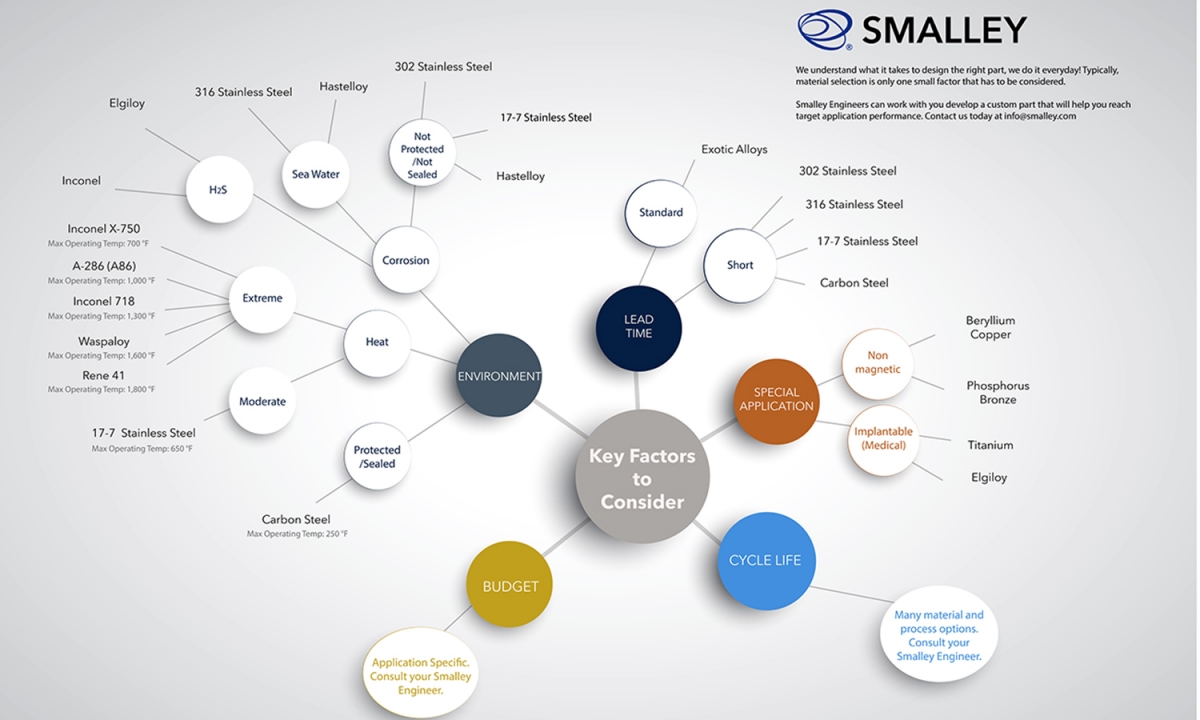
INFOGRAPHIC: KEY FACTORS TO CONSIDER WHEN SELECTING RING AND SPRING MATERIAL
Quick Product Search
Need Help?
Call Us:
+1 (847) 719-5900
General Inquiries
info@smalley.com
Sales
sales@smalley.com
Careers
Join Our Team

© 2026 Smalley. All Rights Reserved.
Connect With Us