Design Custom Ring Help
Use this page to design your own custom ring. Begin by choosing what design
calculations you would like to perform. Next, enter in the design parameters. Press the Calculate
button to display the characteristics of your custom ring. Press the Design button
to refine your design parameters. Once you are satisfied, press the Submit Request
button to send your design to Smalley's Engineering Department.
Smalley offers free technical support from concept through final design. In fact over
50% of Smalley's business is in the design of special rings and springs to suit individual
applications. Whether it's a technical question, delivery concern or a complex spring
design, we're always available and welcome the opportunity to assist you.
Calculate
- Thrust Capacity Ring Shear -- Calculate the thrust load that will shear this ring.
- Thrust Capacity Groove Yield -- Calculate the thrust load that will deform this groove.
- Retained Component Geometry -- Calculate the maximum radius and chamfer for the
retained component.
- Maximum RPM -- Calculate the rotational capacity for an external ring.
- Minimum Edge Margin -- Calculate the minimum edge margin for ring grooves near the edge
of a shaft or housing assembly.
- Installation Stress -- Calculate the stress of installing the ring in the assembly to
ensure it does not set.
Design Parameters
- Units -- The type of units, metric or standard (english).
- Ring Thickness -- Total thickness of an edgewound retaining ring. It may be determined by multiplying the material thickness by the number of turns and adding a keystone value.
- Radial Wall -- Width of a retaining ring when it is measured from inside to
outside edge.
- Number of Turns -- Number of active turns.
- Ring Safety Factor -- Engineering safety factor for ring calculations.
- Ring Type -- Internal ring (housing assembly) or external ring (shaft assembly).
- Actual Load -- Actual thrust load of design.
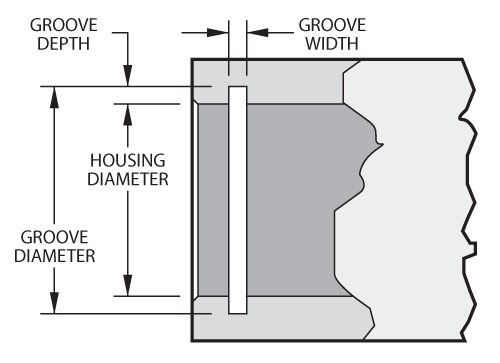
- Housing Diameter -- Diameter of assembly's bore.
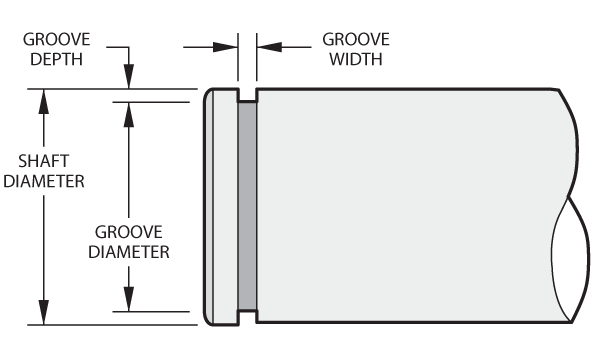
- Shaft Diameter -- Diameter of assembly's shaft.
- Groove Diameter -- Diameter of the groove holding the retaining ring.
- Groove Safety Factor -- Engineering safety factor for groove or assembly calculations.
- Ring Material -- The part's material.
- Shear Strength -- An index of the quality of a material through a mathematical
expression which divides the force required to shear a material by its cross sectional
area. Note: Shear Strength varies according to material thickness.
- Tensile Strength -- An index of the quality of a material through a mathematical expression which divides the material's load capacity in tension by its original cross-sectional area. Note: Tensile Strength varies according to material thickness.
- Modulus -- Modulus of Elasticity is a measure of the rigidity of a material.
- Groove Material -- Material used in the assembly.
- Yield Strength -- The stress at which a material exhibits initial plastic deformation.
Retained Component Geometry
- Maximum Radius -- Maximum radius on a retained component.
- Maximum Chamfer -- Maximum chamfer of a retained component.
Other
- Maximum RPM -- Maximum rotational capacity of an external ring.
- Min. Edge Margin -- Minimum edge margin for ring grooves
near the edge of a shaft or housing assembly.
Thrust Load Capacity
- Ring shear load limit -- Where the shaft or housing material is hardened above the ring hardness, thrust capacity can be substantially increased. Because the groove material resists groove deformation, the ring is subject to shear.
- Groove deformation load limit -- Groove Yield is the capacity at which groove deformation will occur.
- Maximum load of assembly -- The maximum load of an assembly is the smaller of the Ring Shear and Groove Yield.
Installation Stress Analysis
- Stress due to Expansion/Compression -- The stress of installing the ring.
- Minimum Tensile Strength -- The tensile strength of a material that if exceeded by the Stress due to Expansion or Compression will result in a permanent setting of the ring.
See also: