
Call Us: +1 (847) 719-5900
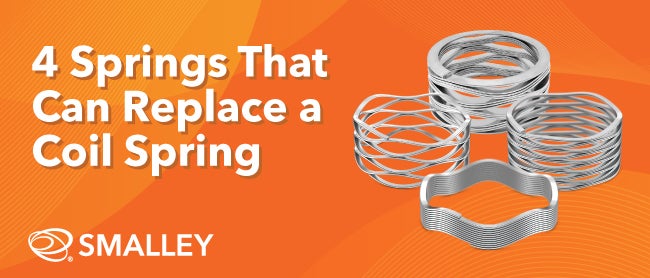
4 Springs That Can Replace a Coil Spring
Key Takeaways
- Wave springs offer alternatives to coil springs with different force, travel, and flexibility.
- Crest-to-Crest® springs deliver the same force and deflection in up to 50% less height.
- Nested springs maximize force in compact spaces.
- Interlaced Wave Springs allow for high loads and medium-to-high deflection in a wide variety of diameters and heights. Primarily used as static springs, they are formed by winding two or three similar Crest-to-Crest springs together, creating a thicker spring.
- Nestawave™ springs balance higher loads and greater travel, while also being suitable for cyclic applications. They are formed from a single piece of wire and, in many cases, are comparable to Interlaced springs.
- Choosing the right spring type can reduce size, improve performance, and lower overall product cost.
Rethinking Traditional Coil Springs
Traditional round wire coil springs have long been the standard for delivering force in mechanical designs, but they can limit how a product performs or how efficiently it can be designed. Wave springs are a major category of springs often overlooked, offering alternative configurations that enable engineers to optimize space, weight, force requirements, and overall design flexibility. By understanding the available options, it becomes easier to select a spring solution that meets specific application needs without being constrained by conventional coil spring designs, reinforcing the idea that Not All Springs Are Equal®.
What Is a Wave Spring?
A wave spring is a compression spring typically made from flat wire and designed to provide axial load in less space than traditional round wire coil springs.
Wave springs feature multiple waves per turn, with certain designs using a single turn. Depending on the design, they can match or exceed the force and deflection capabilities of traditional coil springs while reducing overall spring height. Most wave springs are also available with squared-shim ends, which provide a 360° contact surface. Some wave springs are available as continuous wave-formed wire in a straight, non-coiled form, providing added flexibility for a range of applications.
Why Should You Use Wave Springs Over Coil Springs?
Depending on your application, the right wave spring can allow you to reduce the size of your assembly without sacrificing performance.
By replacing a traditional coil spring, engineers can achieve the same force and deflection in roughly half the height, helping reduce overall assembly size and weight. They can improve reliability and offer flexibility through customizable dimensions and a wide range of materials for different environments and performance requirements. Certain wave springs can also simplify designs by lowering part count.
Which Wave Springs Can Replace a Coil Spring?
- Crest-to-Crest Wave Springs
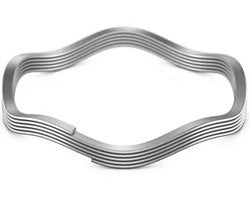
Crest-to-Crest wave springs are multi-turn wave springs that provide the same force and deflection as traditional coil springs while using up to 50% less axial space. Their series-style construction supports longer travel and predictable performance, making them an effective alternative to coil springs in applications where space savings are critical. - Nested Spirawave Wave Springs
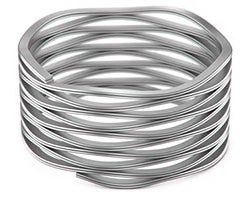
Nested wave springs are high-force multi-turn springs that increase load capacity by stacking multiple turns of wave spring material in parallel from a single continuous wire. This design makes them ideal for high-load applications that require greater force within a compact space. - Interlaced Wave Springs
Interlaced wave springs primarily serve as static springs and are designed to support higher loads by increasing the spring cross-section. They are formed by winding two or three similar Crest-to-Crest springs together, so their turns overlap along the length of the spring. They provide high force with medium-to-large travel and are generally more stable at large diameters and tall free heights than Nestawave springs. - Nestawave Wave Springs
Nestawave wave springs are hybrid wave springs that combine Crest-to-Crest travel with a nested-style design to increase both force and deflection. This allows them to deliver more force than standard Crest-to-Crest springs while maintaining significant travel, making them a versatile solution for applications that require both, all in a compact design. They are generally better than Interlaced wave springs when it comes to cycling. Unlike Interlaced springs, they can be produced with shim ends.

Crest-to-Crest®
Nested Spirawave®
Interlaced Wave Spring
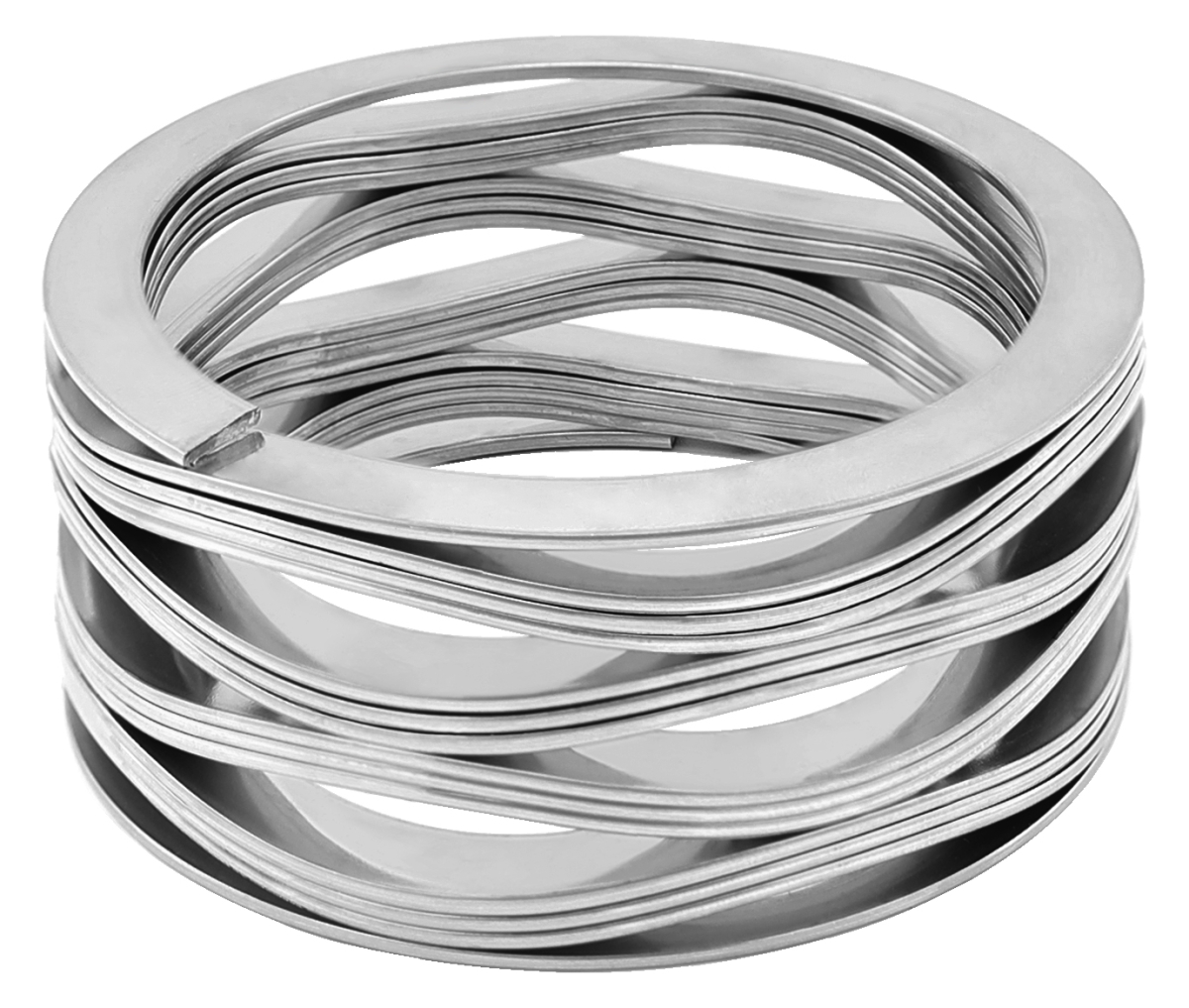
Nestawave Spring
Description
Multi-turn flat wire wave springs coiled in series
Multi-turn flat wire wave springs coiled in parallel
Two to three Crest-to-Crest springs wound together to form one spring
Multi-turn flat wire wave springs coiled in parallel.
Force
Low-Medium
High
High
High
Travel
Medium-Large
Small
Medium-Large
Medium-Large
Each of the following wave spring types is designed to replace a coil spring, but differs in how it delivers force, travel, and overall performance. By understanding these key differences, engineers can select a spring that not only meets load requirements but also improves efficiency, simplifies design, and supports long-term reliability. Choosing the right spring type ensures the best balance of performance and flexibility for each application's specific demands.
With over 100 years of experience, Smalley is the proud inventor and global leader of edgewound wave springs and spiral retaining rings. We offer more than 4,000 standard sizes and a wide range of material options, along with a No Tooling Charges™ policy for custom designs. Whether you need a standard component or a highly specialized solution, our team can work with you to develop a spring that meets your exact application requirements.
For a deeper look at Smalley’s wave spring technology and custom capabilities, download our free eBook, Designing with Wave Springs.
Additional Information
Quick Product Search
Need Help?
Call Us:
+1 (847) 719-5900
General Inquiries
info@smalley.com
Sales
sales@smalley.com
Careers
Join Our Team

© 2026 Smalley. All Rights Reserved.
Connect With Us